Module Overview
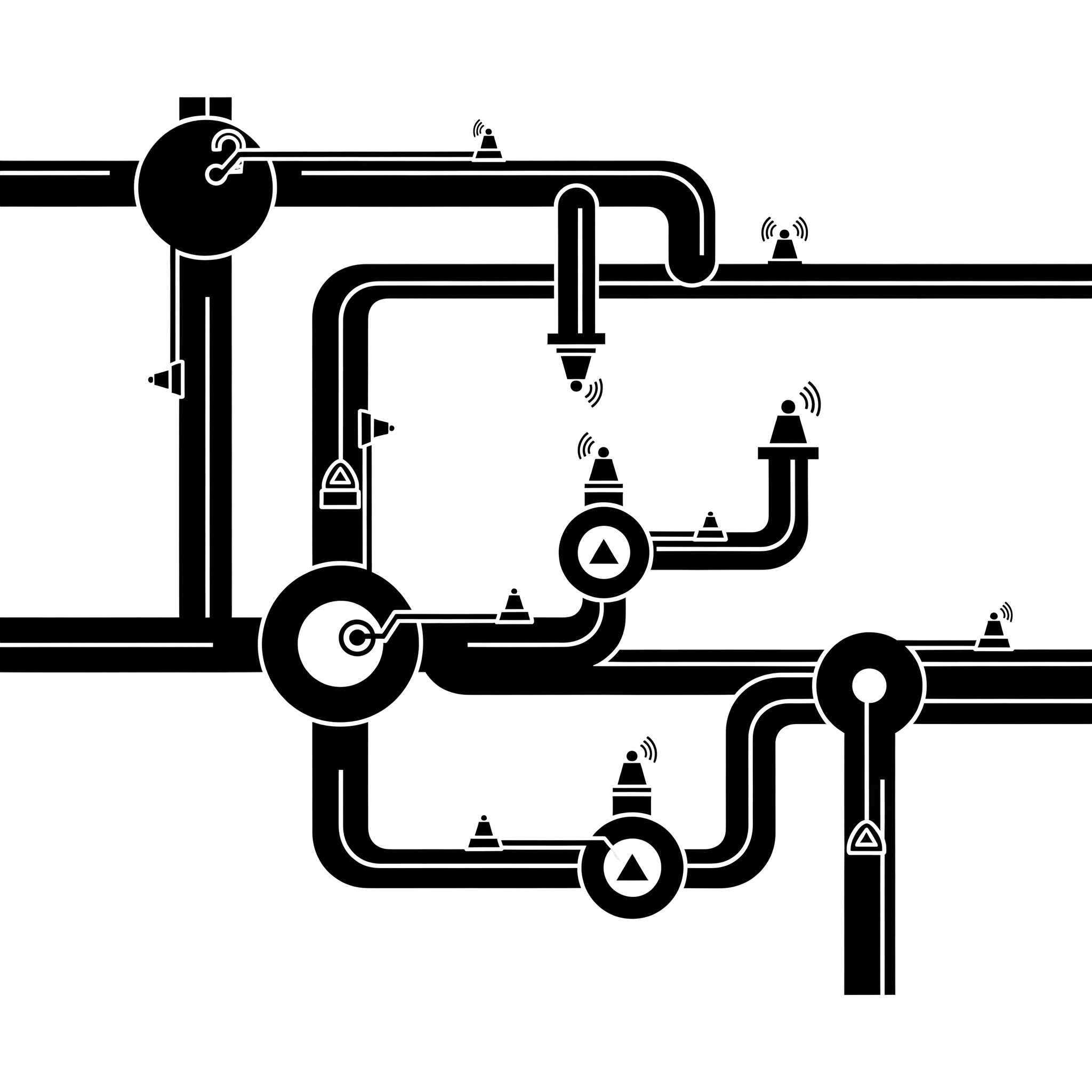
Sensor Placement
In a water distribution network, the strategic placement of flow and pressure sensors
is critical for effective monitoring, early leak detection, and reliable operation,
while keeping instrumentation costs within practical limits.
Conventional sensor placement approaches typically rely only on hydraulic variables
such as pressure and flow, often overlooking the underlying network topology and
connectivity between nodes. This can lead to inefficient coverage and unobserved
"blind spots" in the network.
The Sensor Placement module in SmartNet jointly considers network hydraulics and
topology to determine optimal sensor locations under budget constraints. By analysing
node connectivity, distances, and sensitivity relationships, the module identifies
sensor layouts that maximize observability while minimizing redundancy.
Users can choose between two optimization strategies:
a lexicographic approach that prioritizes cost minimization before coverage, and
a goal programming approach that balances multiple objectives through weighted targets.
The recommended sensor locations are highlighted directly on the network,
and the outputs seamlessly support downstream modules such as calibration
and leak detection.

Scheduler
Efficient operation of water distribution networks requires coordinated scheduling
of pumps, valves, and storage tanks to meet time-varying demands while maintaining
hydraulic reliability and minimizing operational costs.
While most hydraulic tools assume continuous supply, many real-world networks,
especially in developing regions, operate under intermittent supply conditions.
These systems exhibit strong temporal variations in flow, pressure, and storage
behavior, making conventional analysis insufficient.
The SmartNet Scheduler module explicitly models time-based operation and storage
dynamics, making it suitable for both continuous and intermittent supply systems.
It incorporates demand patterns, tank capacities, and operational constraints to
generate feasible schedules that balance supply availability with distribution limits.
The generated schedules are visualized using time-series plots of tank volumes,
flow rates, and estimated energy consumption, enabling users to assess system
performance and operational efficiency. The module directly supports performance
analysis, energy optimization, and decision support for resilient network operation.
Designer
The Network Designer module supports the hydraulic design of branched and looped
water distribution networks by optimizing pipe diameters while satisfying
pressure and flow constraints.
Traditional network design is often carried out using manual iterations or
rule-based assumptions, which can result in oversizing and inefficient material use.
The Designer module addresses this challenge through an optimization-driven framework
that automates pipe sizing based on hydraulic performance and engineering constraints.
The module operates on EPANET input models and currently supports networks comprising
junctions, demand nodes, and a single reservoir connected through pipes.
Users define allowable pipe diameters, minimum pressure requirements, and velocity
bounds to ensure practical and reliable designs.
Optimized designs are visualized interactively, and the resulting network can be
exported in EPANET format or directly passed to other SmartNet modules such as
sensor placement and scheduling, enabling a seamless transition from design
to operation.
Leak Detection
Leakage is a major contributor to non-revenue water and water scarcity in
distribution networks, particularly in ageing urban systems.
Leaks commonly occur at pipe joints, valves, and service connections due to
pressure fluctuations, material degradation, and external stresses.
The Leak Detection module in SmartNet supports systematic identification and
localization of leaks using hydraulic modeling and data-driven analysis.
The module operates on EPANET-based networks and allows users to define
time-varying demand patterns for realistic simulation.
Leak detection is performed by analysing deviations in flow behaviour over
user-defined time windows using a configurable leak indication factor.
Abnormal patterns are flagged as potential leak events, after which localization
is carried out using edge-level flow information.
The results are visualized directly on the network map, enabling intuitive
interpretation and targeted field investigation. Integration with the Sensor
Placement and Scheduler modules further improves detection accuracy and supports
proactive reduction of non-revenue water.